Breaking: U.S. Captures Maduro
Unpacking the Motivations Behind the January 3rd
Military Operation
A U.S. military operation captured Venezuelan President
Nicolás Maduro on January 3, 2026. We analyzed the
official justification, economic drivers, geopolitical
implications, and public reaction to understand what's
really at stake.
|
|
Key Finding
Oil Is The Primary Driver
Venezuela holds 303 billion barrels—the world's largest
proven reserves
|
The Official Justification
The Trump administration framed the operation as a law
enforcement action against narco-terrorism. Maduro faces
charges from a 2020 indictment for conspiracy to commit
drug terrorism, cocaine importation, and possession of
destructive devices. Trump accused Maduro of leading the
"Cartel de los Soles" and using Venezuela as a
narco-state.
|
The Reality: Multiple Overlapping Motivations
Our analysis reveals a complex web of interconnected
motivations that go far beyond the stated
narco-terrorism justification—with oil access emerging
as the dominant economic driver.
|
The Seven Key Motivations
|
1. Oil and Energy Resources (Primary Economic Driver)
Venezuela possesses the world's largest proven oil
reserves—approximately
303 billion barrels. Trump explicitly
stated that U.S. oil companies would be allowed to
invest billions to rebuild Venezuela's deteriorated oil
infrastructure.
"We are in the oil business, we will sell oil from
Venezuela. It's gonna make a lot of money" — Donald
Trump
|
2. The "Trump Corollary" to the Monroe Doctrine
The December 2025 National Security Strategy introduced
what analysts call the "Trump Corollary"—a reassertion
of U.S. dominance over the Western Hemisphere. This
strategy explicitly prioritizes:
- Preventing migration from Latin America
-
Combating organized crime through military means
- Securing access to energy and mineral resources
- Limiting Chinese and Russian influence
|
3. Countering Chinese and Russian Influence
Venezuela has deepened alliances with China, Russia, and
Iran under Maduro. Before the operation, Venezuela
exported approximately
500,000 barrels per day, mostly to China.
Some analysts speculate this could be about "choking
China's oil supply in a Taiwan showdown"—suggesting the
operation serves broader geopolitical competition with
Beijing.
|
4. Migration Control
Over 8 million Venezuelans have fled
the country's humanitarian crisis. Trump has repeatedly
blamed Maduro for releasing criminals who migrate to the
U.S. Controlling Venezuela could theoretically reduce
migration flows—though experts warn the operation may
actually create more refugees.
|
5. Domestic Political Messaging
The operation serves multiple domestic political
purposes:
-
Demonstrating strength: Trump watched
the operation "like a TV show" from Mar-a-Lago and
released photos of Maduro in handcuffs
-
Fulfilling campaign promises: Framing
this as law enforcement rather than war
-
Appeal to Latino voters:
Venezuelan-Americans and Cuban-Americans in Florida
strongly opposed Maduro
|
6. Legal and Procedural Innovation
The administration used what analysts call the
"police operation loophole"—bringing
FBI agents alongside Delta Force to frame the military
action as law enforcement executing arrest warrants
rather than an act of war. This avoided Congressional
approval requirements.
|
7. Rare Earth Minerals and Strategic Resources
Beyond oil, Venezuela possesses significant mineral
resources that could be strategically valuable for AI
and technology development—making this operation part of
the "AI geo-political lens which has been the story
since rare earth became the new oil."
|
Public Reaction: Social Media Analysis
|
X (Twitter): Oil Dominates the Conversation
Multiple users cited oil as the primary motivation, with
overwhelming consensus that the narco-terrorism
justification is secondary:
-
Trump's own statements about selling Venezuelan oil
were widely shared
-
Speculation about cutting off China's oil supply
gained traction
-
Users pointed out the "police operation loophole" to
bypass Congress
|
Reddit: Skeptical of Post-Operation Planning
Across multiple subreddits, users expressed concern
about what comes next:
-
Interim leader Delcy Rodríguez immediately rejected
U.S. authority
-
Chavista regime structure remains intact despite
Maduro's capture
-
Comparisons to the 1989 Panama invasion were common
-
Questions about the operation's legality raised by
bipartisan Senators
|
Critical Concerns and Contradictions
|
|
The Drug Trafficking Justification Doesn't
Hold:
Rep. Alexandria Ocasio-Cortez noted that if this were
about drugs, Trump wouldn't have recently pardoned major
drug traffickers. The narco-terrorism charges existed
since 2020 without military action.
No Clear Governance Plan: The operation
captured Maduro but left the chavista regime structure
intact, with Vice President Rodríguez denying U.S.
authority.
Failed Diplomacy: A last-ditch deal to
exile Maduro to Turkey fell apart in late December,
suggesting Trump preferred military action over
negotiated settlement.
Infrastructure Challenges: Even with
U.S. control, Venezuela's oil infrastructure is so
degraded that recovery would take years, not months.
|
Interactive Analysis Dashboard
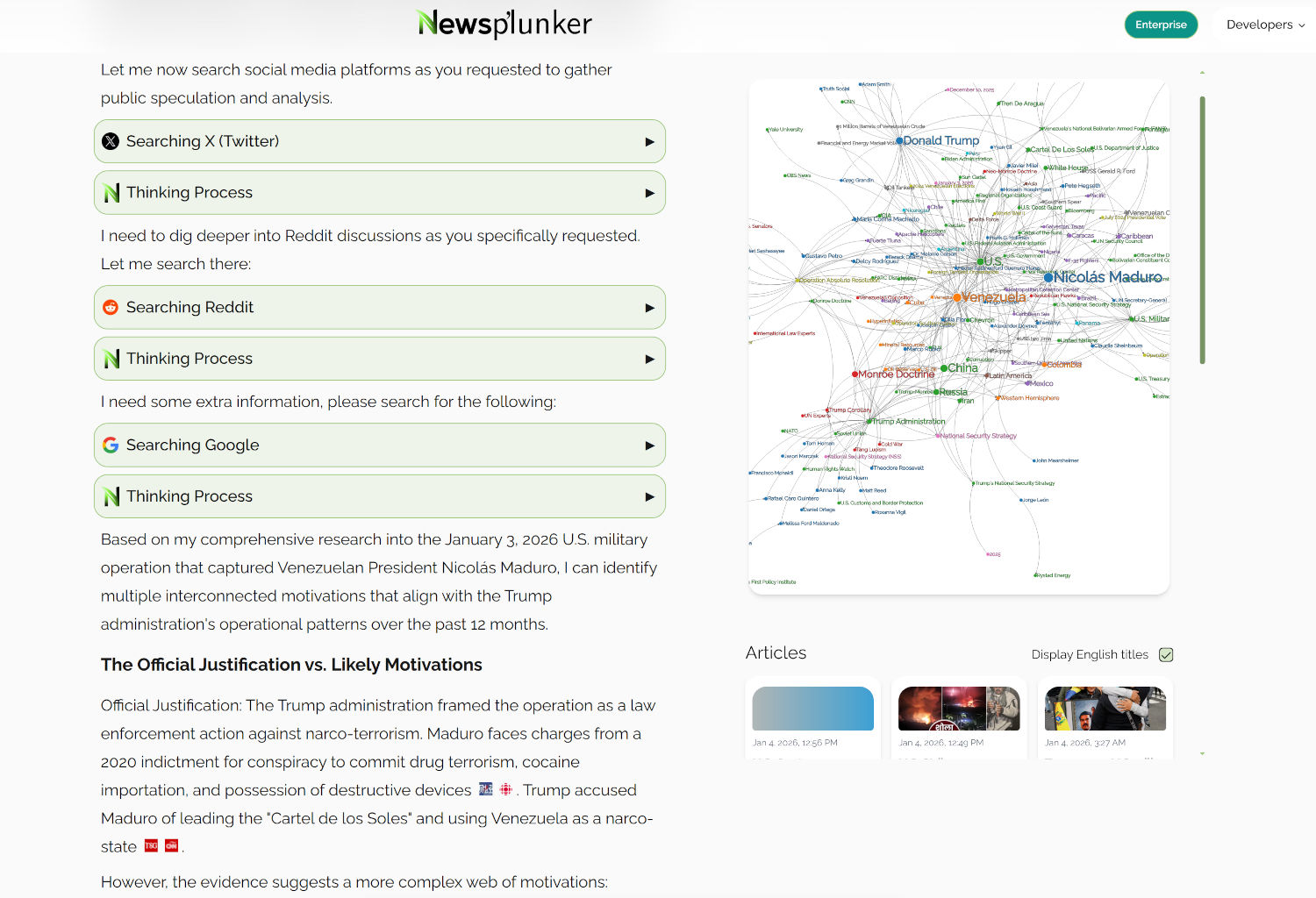
Click the image above to explore the full interactive
dashboard
|
What This Means
The Venezuela operation represents the most aggressive
U.S. military intervention in Latin America since the
1989 Panama invasion. It reflects the Trump
administration's fundamental approach:
transactional, unilateral, focused on immediate
tangible gains, and willing to bypass traditional legal and
diplomatic channels.
The most likely explanation is that multiple overlapping
objectives are at play, with
oil access being the dominant economic driver, combined with geopolitical positioning against
China/Russia, implementation of the "Trump Corollary"
doctrine, migration control, and domestic political
messaging.
The operation signals to Latin America that the U.S.
will use military force to assert its interests—a
development with far-reaching implications for
hemispheric relations.
|
|
About NewsPlunker
NewsPlunker by AskNews provides comprehensive analysis
powered by advanced AI and real-time news intelligence.
Get deeper insights into the stories that matter most.
Join our Discord community or email us at
[email protected].

|
|
AskNews - News, when quality matters.
Emergent Methods, LLC, Denver Colorado, USA
Unsubscribe
© 2026 Emergent Methods LLC All rights reserved.
|
|
|