

From Retrieval to Citation: How AskNews Makes Publisher Usage Traceable
When your reporting enters an AI research workflow, you need to know what happened to it. Our enterprise clients run AI agents that use AskNews directly, through our API, MCP server or CLI, to build news analytics workflows. Those agents need to know where the evidence behind an answer came from. At AskNews, traceability serves both needs: it helps publishers understand usage and helps clients check the reporting behind their agents' work.
A retrieval count tells only part of that story. Was the material fetched and set aside, included in a model's context, or cited in an answer? We integrate SPUR telemetry to distinguish those uses, then apply our own weighting policy when allocating the publisher revenue pool.
The same reporting, different questions
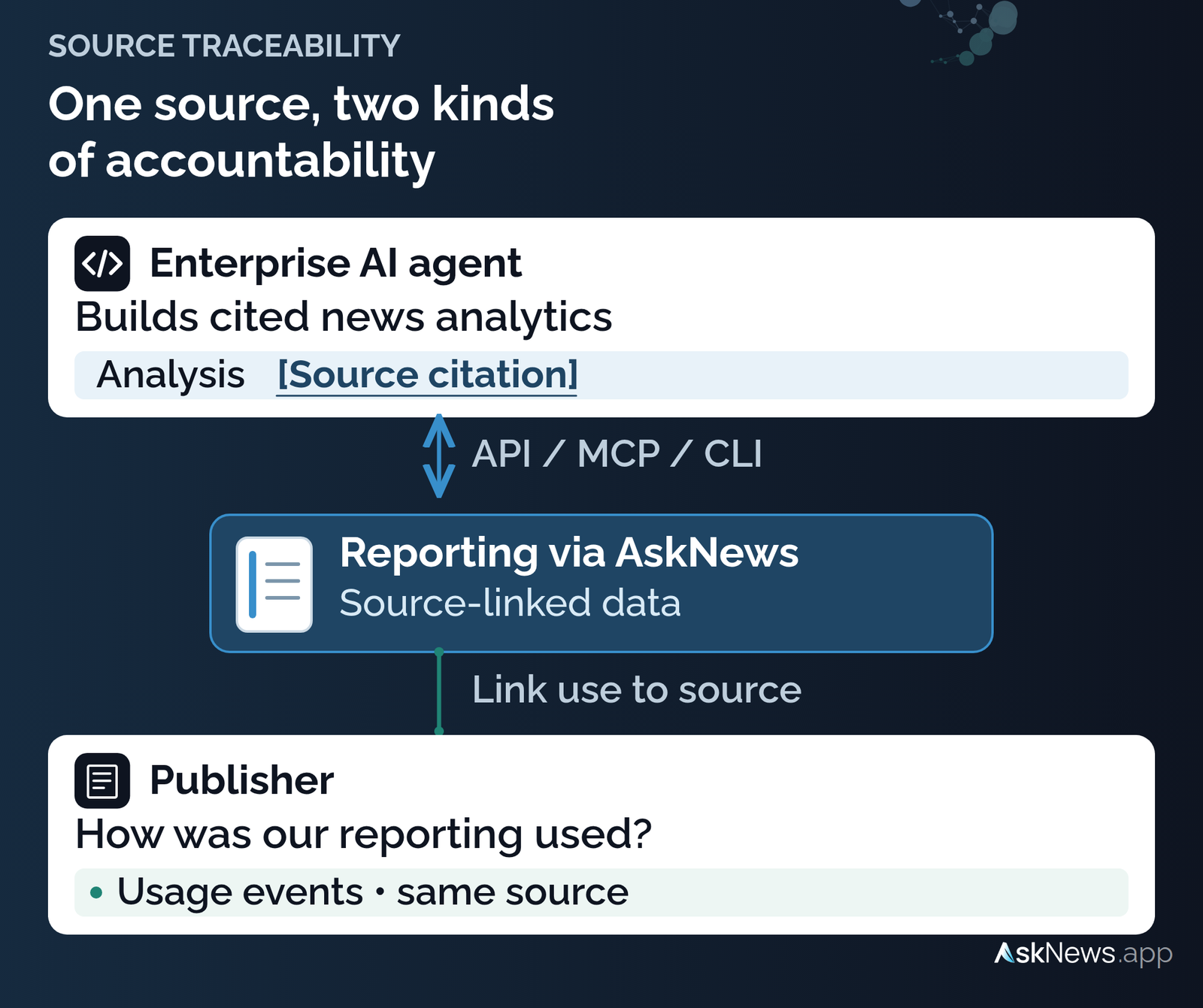
For a publisher, traceability connects activity in an AI workflow back to the journalism that made it possible. Without that connection, a usage total says little about which reporting contributed or how it was used.
For an enterprise AI agent, the connection runs in the other direction: from a conclusion back to evidence. An agent investigating a company or a policy change needs to preserve the source, revisit earlier reporting, and distinguish an original account from a later correction.
We described this client requirement in What AI Agents Need from News Retrieval. Keeping the cited passage, source identity and time information makes an answer inspectable. It also lets the agent follow up when new evidence changes the question, and lets a person reviewing the output check its sources.
These interests meet at the original reporting. A useful evaluation asks both whether the publisher can understand the reported use and whether the agent's output lets a reader check the source behind a claim.
Give each kind of use a shared meaning
Telemetry means records of what a system reports happened. The Content Telemetry standard maintained by SPUR gives those records common definitions and a shared format. That matters whenever a publisher, a data provider and an AI application need to interpret the same activity.
The SPUR public-comment announcement introduced the work as draft specifications. As of September 2026, Content Telemetry is version 1.0; the separate SPUR publisher profile, which adds publisher-facing delivery requirements, is version 0.2 Preview.
The distinction is practical. The core defines what an event means. The profile adds requirements for delivering telemetry to publishers. Our commercial policy decides how reported uses affect allocation. A usage record neither grants permission nor sets a price; those belong in the applicable agreement.
Follow a piece of reporting from retrieval to citation
Consider an illustrative workflow, rather than a customer result or a payout calculation. Your newsroom has covered a local policy change. An enterprise client's AI agent is asked how it could affect nearby businesses.
Through AskNews, the agent can retrieve a synthetic representation of that reporting: structured factual information prepared for machines, without reproducing the article's distinctive narrative voice. Publishers control what part of their synthetic data is shared.
The standard distinguishes the following events:
- Retrieval: the application completes a fetch of the representation. It has obtained material that could help answer the question. Retrieval alone does not establish that the material entered the model's context.
- Grounding: the material enters the context used to generate an answer. It is now available to the model, but that event does not prove the model relied on it or produced a correct conclusion.
- Citation: the output explicitly associates a source with the answer or a claim, using a reference that can be resolved back to that source. This records attribution in the output, rather than merely the availability of material beforehand.
Citation also differs from delivery. The protocol separately describes presentation, when content or a source reference becomes perceivable on a recipient-facing surface, and engagement, an observed action such as a click. A citation record alone proves neither a visit to your website nor that the cited reporting supports the answer correctly.
Nor should these categories be read as a rigid funnel. An application can reuse cached material without fetching it again. An output can contain a citation without a matching grounding event. When interpreting totals, check which events were reported and what each count represents before comparing them.
How we weight usage in the publisher revenue pool
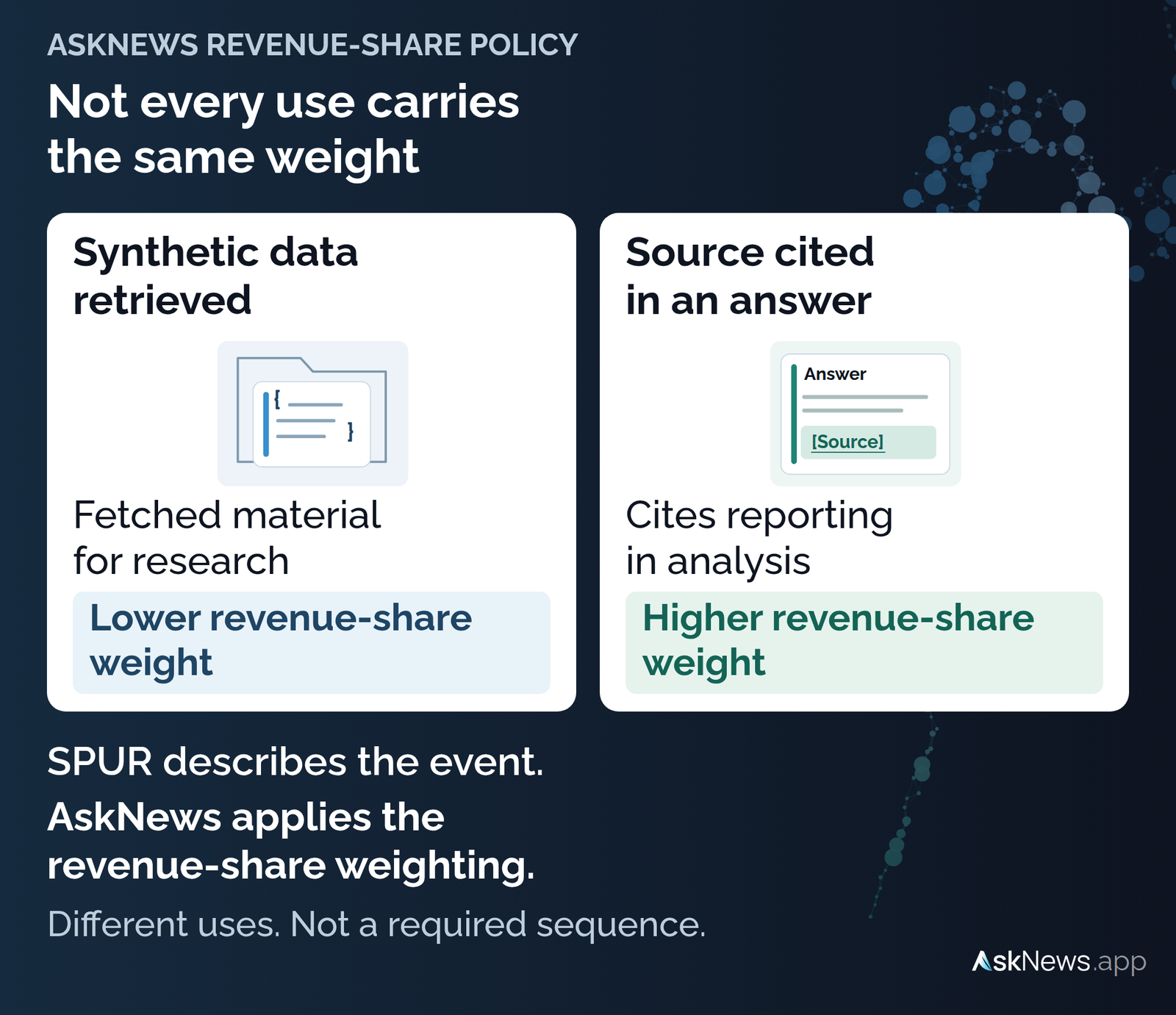
We use telemetry signals to give different uses different commercial significance. Retrieving synthetic data is a low-value event under our allocation policy. A citation is a high-value event and increases the publisher's share of the revenue pool.
Obtaining material and explicitly associating it with an answer have different meanings. Calling both a “use” would hide that difference.
The usage record describes what was reported. Our weighting policy determines how that use contributes to a publisher's share.
This is AskNews policy. SPUR supplies shared signals and leaves commercial counting to agreements between the parties. It prescribes no royalty formula.
Low-value retrieval does not mean worthless or necessarily unpaid retrieval. Equally, a higher share does not promise a particular cash payment: the revenue pool and the applicable commercial arrangement still matter. Read usage reporting alongside the terms governing compensation.
Read the dashboard as two related views
Our publisher dashboard makes that conversation concrete. The sanitized example below places a Revenue Summary alongside Publisher Metric Events, with labels for Indexed, Retrievals, Groundings and Citations.
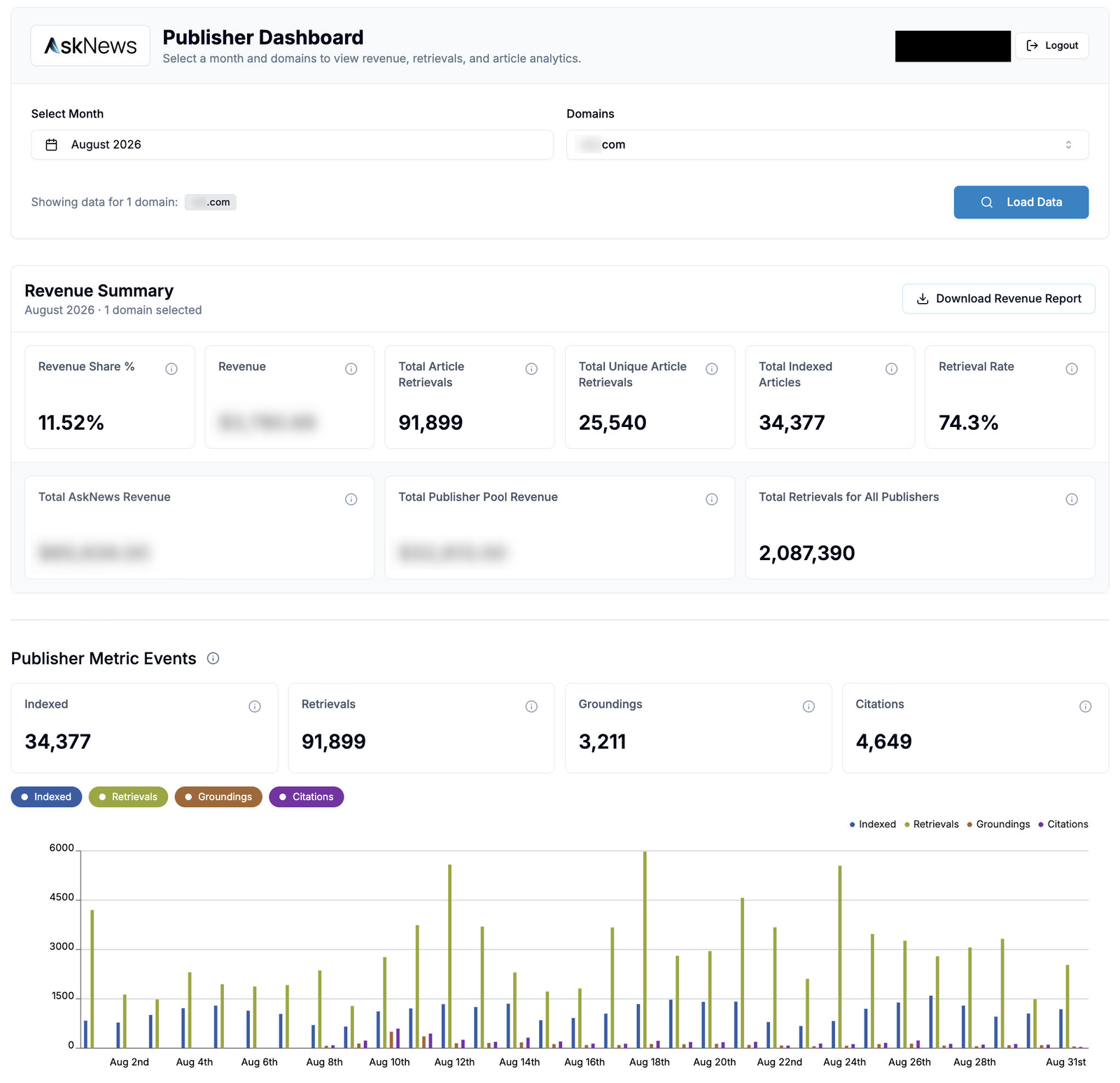
An AskNews publisher dashboard example for August 2026. Usage and revenue reporting appear together; the example figures are not a promise of results
“Indexed” describes the collection; it is not another core usage-event category alongside retrieval, grounding and citation.
For a publisher reviewing a report, the useful questions are concrete: which reporting period and publication does it cover, which kinds of use are included, and how does the agreed allocation policy apply? AskNews shows more data beyond the screenshot, including per-article analytics, metadata profiles across popular and unpopular articles, and more. Even better - it is all available via API for custom integrations of these analytics.
Why a shared protocol matters
A dashboard is easier to interpret when the underlying terms mean the same thing across organizations. Common definitions reduce ambiguity: a fetch should not become a citation simply because a different provider calls both “usage.”
A shared format also supports interoperability. Applications that report events and systems that receive them have a common structure to work with, rather than a separate vocabulary for every relationship. Compatible versions and implementation choices still matter.
Accountability follows from making the record inspectable. Source identities, timestamps and explicit reporting coverage help parties ask what a report includes and where gaps remain. Events remain claims made by the reporting system; standardization alone does not independently verify their truth or completeness.
Trust also requires proportionate disclosure. Publishers need meaningful usage information, while enterprise clients may need to protect private research questions. The standard includes privacy controls, and the publisher profile does not require disclosure of query intent. Reporting requirements should make those boundaries clear.
For us, the goal is a relationship publishers and clients can examine: reporting remains identifiable, different uses have clear meanings, and the commercial policy is explained separately. Shared telemetry gives that conversation a common starting point.
Explore AskNews Publisher to discuss licensing your feeds, understanding usage reporting, and how our revenue-share model applies to your publication.