Why Your Team Shouldn't Build Its Own News Ingestion Pipeline
Every team that builds an AI system needing current-events context eventually asks the same question: how hard can it be to scrape some news sites?
The honest answer: not hard to start, and very hard to keep working. Teams that go down this path usually end up building a maintenance job, one that also blocks them from the data they actually wanted.
We've watched this pattern enough times to write down exactly where the build path breaks. Usually we hear about it because a team comes to us after trying it themselves.
The pipeline looks simple on a whiteboard
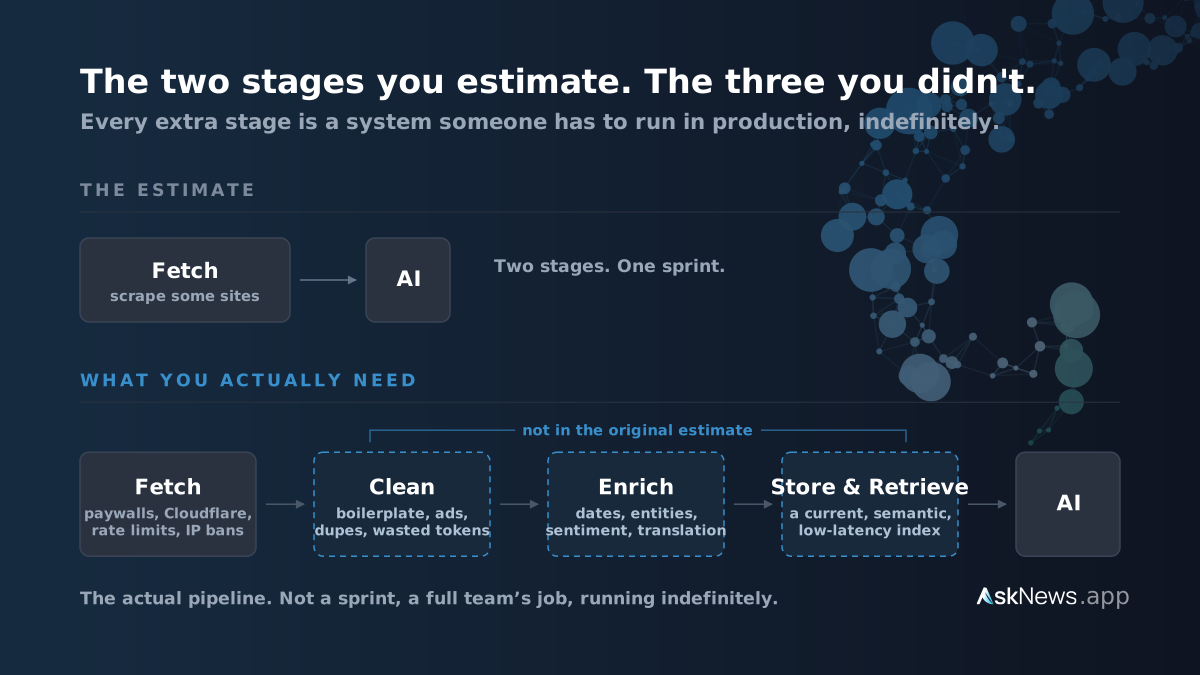
The naive version of this project is two steps: fetch some articles, hand them to the AI. That's usually where the estimate comes from, and it's why the estimate is wrong. Each step hides months of unglamorous engineering that only becomes visible once the system is in production.
Fetch is the part people plan for, and even that is harder than it looks. The sources that matter most (the major wires, the national dailies, the trade and financial press) are paywalled or actively block automated access. Cloudflare, rate limits, and IP bans turn "write a scraper" into maintaining an adversarial relationship with every site you depend on.
Clean is the part people skip in the estimate entirely. Raw HTML is not context: it's boilerplate, ads, navigation chrome, and five near-identical articles about the same press release. An AI can technically read that, but "technically works" and "works well in production" are different bars. Cleaning isn't just about giving the AI a clearer signal, though that matters. It's about token cost. In a demo, nobody notices that half the prompt is HTML cruft. In production, at volume, that waste is a line item, and it's often the line item that decides whether the system is economical to run at all.
Store and retrieve is the part naive implementations don't budget for because the demo doesn't need it. If your AI system asks for context once, fetching fresh works fine. A production system asks for context constantly, often inside an agent loop where the AI calls out for information multiple times per task, and re-fetching from the open web on every call is too slow and too unreliable to build on. You need an index that's already current, that can be queried with low latency, and that can be searched semantically, not just by keyword. That's a retrieval system in its own right, not a side effect of fetching.
None of this is exotic engineering. But fetch, clean, and retrieve, running in production indefinitely, at low latency and controlled token cost, is a full team's job, not a sprint.
The costs that don't show up in the initial estimate
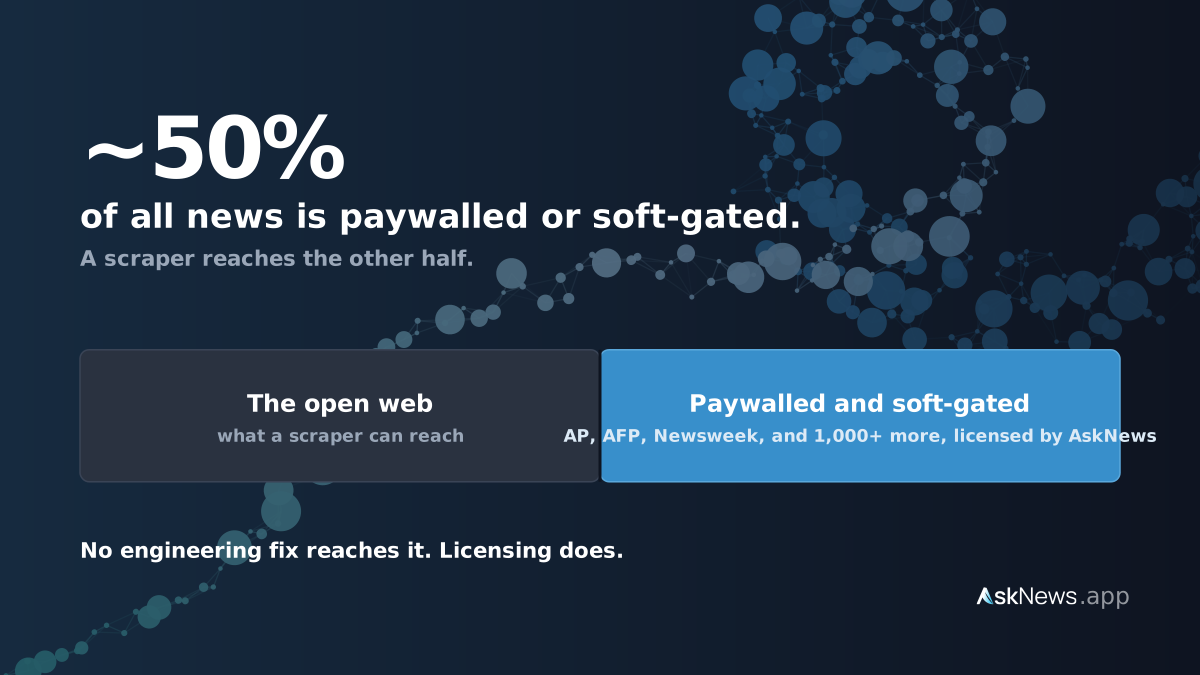
Paywalls are half the story, and the good half. Roughly half of all news is behind hard or soft paywalls, and publishers are only getting better at blocking bots. That includes the major wires and most investigative and enterprise reporting. A scraper that only reaches the open web is, by construction, missing the highest-signal half of the news ecosystem. There's no engineering fix for this. It's a licensing problem, and licensing takes years of publisher relationships to build.
Scraping is legally and operationally brittle. Most publisher terms of service prohibit exactly what a scraper does. Beyond the legal exposure, scraped infrastructure breaks constantly and without warning: a layout change, a new bot-detection rule, a Cloudflare update. Someone on your team has to notice, diagnose, and patch it, indefinitely. Teams that have been through this describe maintaining a system that seems actively hostile to being maintained.
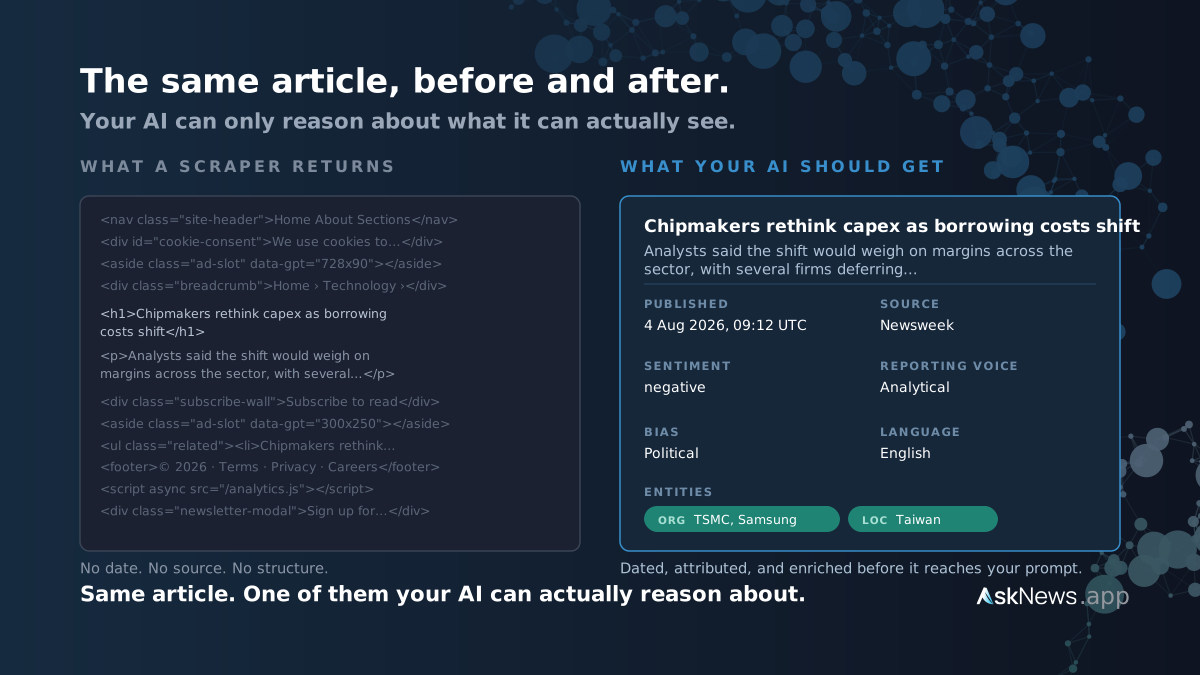
Noisy context doesn't just cost tokens, it costs correctness. An AI system given a scraped, undated, duplicate-laden dump of HTML doesn't just run up your bill. It hallucinates, because it has no reliable way to tell what's current, what's redundant, or what's even relevant. This is the "garbage in, garbage out" problem, and it's not abstract: in our own evaluation of context quality across providers using RAGAS (Context is King), providers that omitted basic metadata like publication dates fell apart on time-sensitive questions, while entity extraction and sentiment labeling measurably improved answer correctness. An AI system that can see a clearly dated, deduplicated, entity-tagged article behaves differently than one guessing at a wall of raw markup.
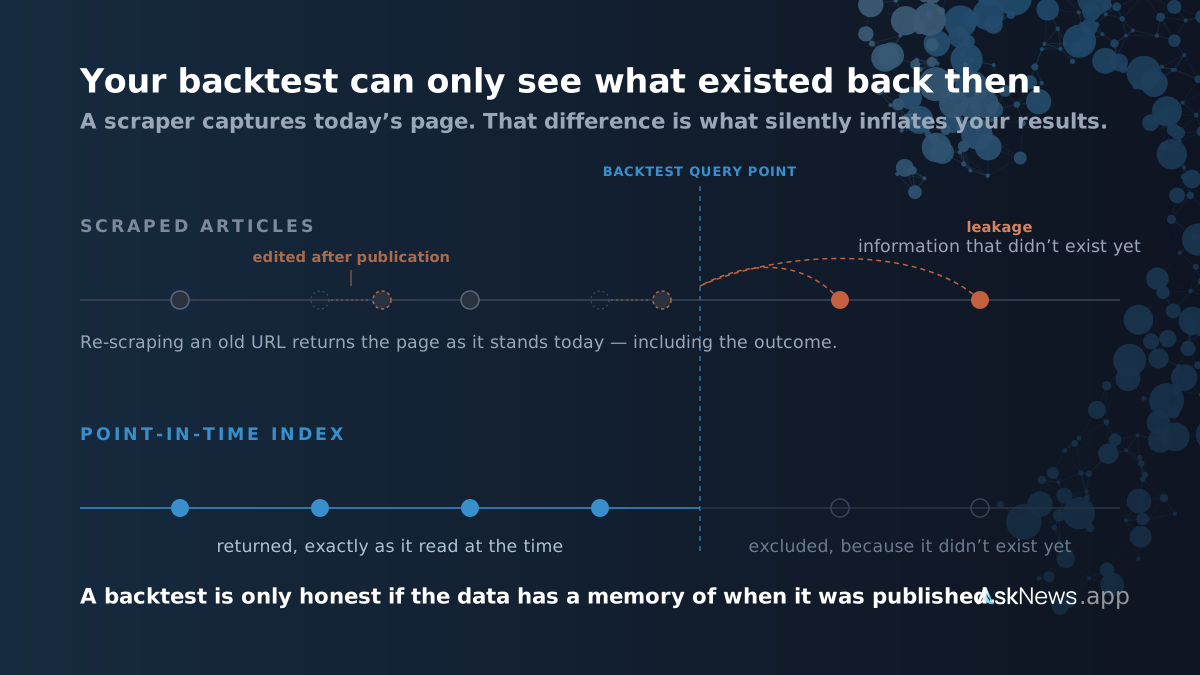
Scraped data can't reliably reconstruct the past. If you're building or backtesting a forecasting system, you need to know exactly what information was available at a specific point in time, not what a website looks like today, retroactively. Scrapers capture the present. They don't give you a clean historical record you can trust for backtesting, so any backtest built on scraped archives risks silent data leakage: your AI "predicting" an event using information it only could have seen after the fact.
What "build" actually costs
Add it up: publisher access you legally can't get without a hard-earned license agreement, infrastructure that breaks on someone else's schedule, an enrichment pipeline that needs its own ML expertise, and a historical record you can't fully trust. Teams that attempt this in-house rarely end up with a moat. More often they end up with a tax on every other part of the roadmap. The engineers who could be improving your forecasting model or your agent's reasoning are instead patching a scraper that Cloudflare broke overnight.
Most teams don't stay on the build path for long. They hit a wall: bad data poisoning a report, a scraper going dark during an actual event, a compliance review that flags scraped content. Then they start looking for someone who's already solved it.
What outsourcing actually buys you
Treat news ingestion as infrastructure you buy, the same way most teams buy compute, auth, or payments instead of building their own.
Licensed access to the data you can't scrape. Formal agreements with AP, AFP, Newsweek, Time, Forbes, The Telegraph, and 1,000+ publishers worldwide bring paywalled sources within reach, alongside open web coverage across 200+ countries and dozens of languages, translated and normalized.
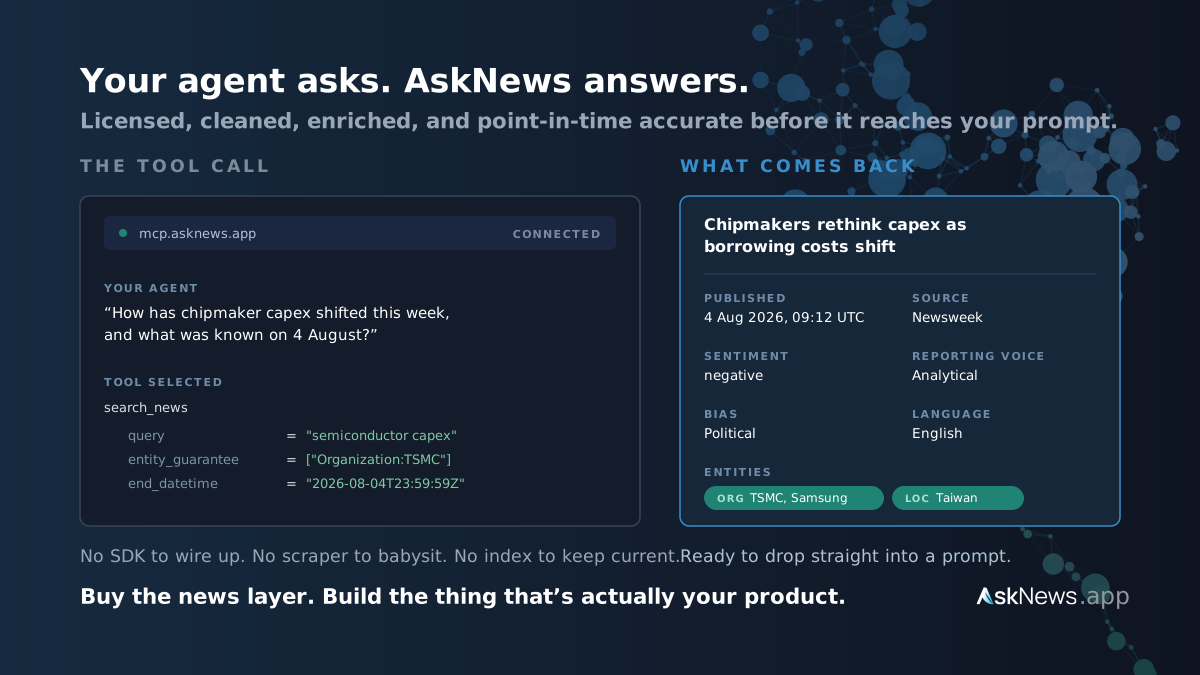
Data that's already usable, not just retrieved. Every article is cleaned, deduplicated, translated, and enriched with entities, relationships, geocoordinates, sentiment, and bias labels before it ever reaches your prompt. That's the difference between handing your AI 400 clean, relevant data points and handing it 15 noisy HTML dumps it has to make sense of on its own. You pay for quality once, upfront, instead of paying for cleanup on every single call.
A historical record you can actually trust. For any system that needs to backtest against the past, forecasting models, research agents, evaluation pipelines, you need the ability to query only the news that existed at a given point in time, with no future information leaking in. Scrapers were never built to preserve a trustworthy timeline in the first place, so they can't offer this.
A legally clean foundation. Licensed data means publishers get paid, and your legal team doesn't have to litigate a gray area every time procurement asks where your data comes from. That matters more, not less, as scraping-based tools face growing scrutiny.
The real trade-off
The build-vs-buy question isn't really about whether your engineers could build a scraper. They could. The question is whether that's the highest-leverage thing for them to spend the next year maintaining, given that it's an adversarial relationship with the open web that still can't reach half of the news that matters, when they could be focused on the forecasting model, the agent, or the research workflow that's actually your product.
Teams building serious AI systems (forecasting labs, geopolitical risk monitors, research agents) have increasingly landed on the same answer: license the news layer, and build the thing that's actually differentiated on top of it.
We built AskNews to be that layer: licensed, enriched, temporally accurate news data, delivered through an API built for AI systems. That layer meets your stack where it already is. REST for anything. SDKs for Python, TypeScript, PHP, and Go. An MCP server that drops licensed news into Claude, ChatGPT, or a coding agent as a tool. And a CLI, so the same data is one command away in a script, a CI job, or an agent that would rather shell out than speak MCP. Whichever way your system reaches for news, none of it is plumbing you have to write.
If your team is weighing whether to build this yourselves, talk to us or just try the API and see what clean data does to your downstream costs.