

AskNews at TechEx 2026: the question that won €400
For two days at TechEx 2026, the AskNews booth ran a single challenge: the deepest search wins €400. The winning entry came from Moussa Gerges, and his question is worth a close read for anyone building AI agents or research workflows. It shows how much ground an iterative research agent covers when a question gives it real reasons to keep going, and where even a deep run runs out of evidence.
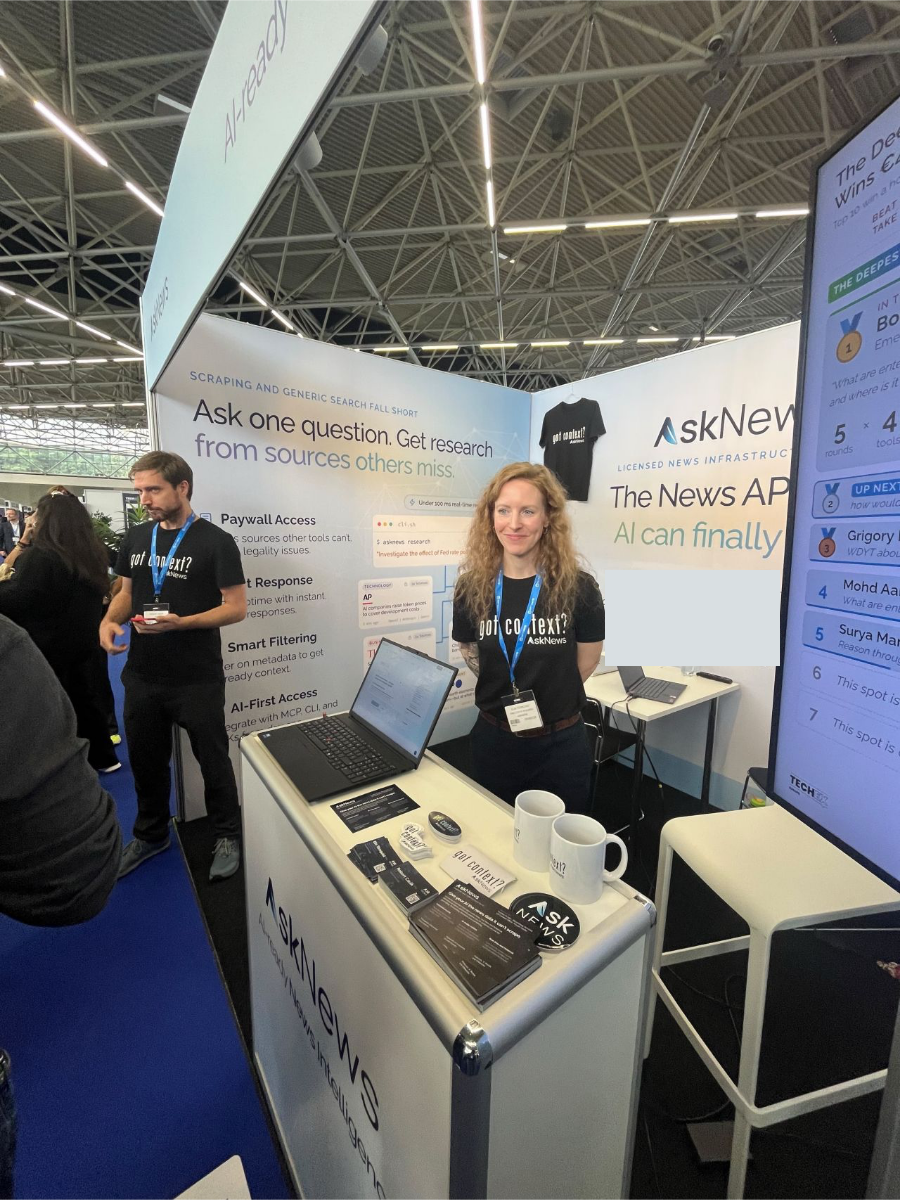
Two days at the booth and the demand for better news context
TechEx draws technology leaders, transformation executives, innovators and solution providers from enterprise, the public sector and the wider technology ecosystem. The AskNews stand invited them to try a deep news research question and compete for depth. Participation earned a T-shirt, the top ten were in line for hoodies, and the deepest search would take the €400.
The prize was the hook. The conversations were the surprise. The team had not expected to meet so many people already looking for quality news data. A theme kept coming up, in the team's account of those conversations: a typical Claude web search scratches the surface when the job needs depth. Attendees talked about three needs in particular. They wanted research that keeps digging past the first pass. They wanted access to licensed, paywalled reporting that open search does not reach. And they wanted structured, enriched news data their agents could reason over directly.
Those are the team's observations from one event, and they are not a benchmark. They did line up closely with what AskNews is built to be: a licensed news intelligence layer for AI systems that need high-quality real-time and historical context, delivered as structured, enriched news for research and forecasting workflows.
Moussa's winning question and the actual research
The scoring was deliberately simple. Each entry earned its research rounds multiplied by the number of distinct tools that returned results. Ties would fall to cited sources, then to the earliest post, and each entrant's best post counted. The rules also set out the spirit of the game: a question telling the agent how to search would not be entered, because the craft was meant to live in the question.
When entries closed, 31 people had competed. Moussa Gerges finished first with 15 research rounds across 6 distinct tools, for 90 points. The runner-up scored 55.
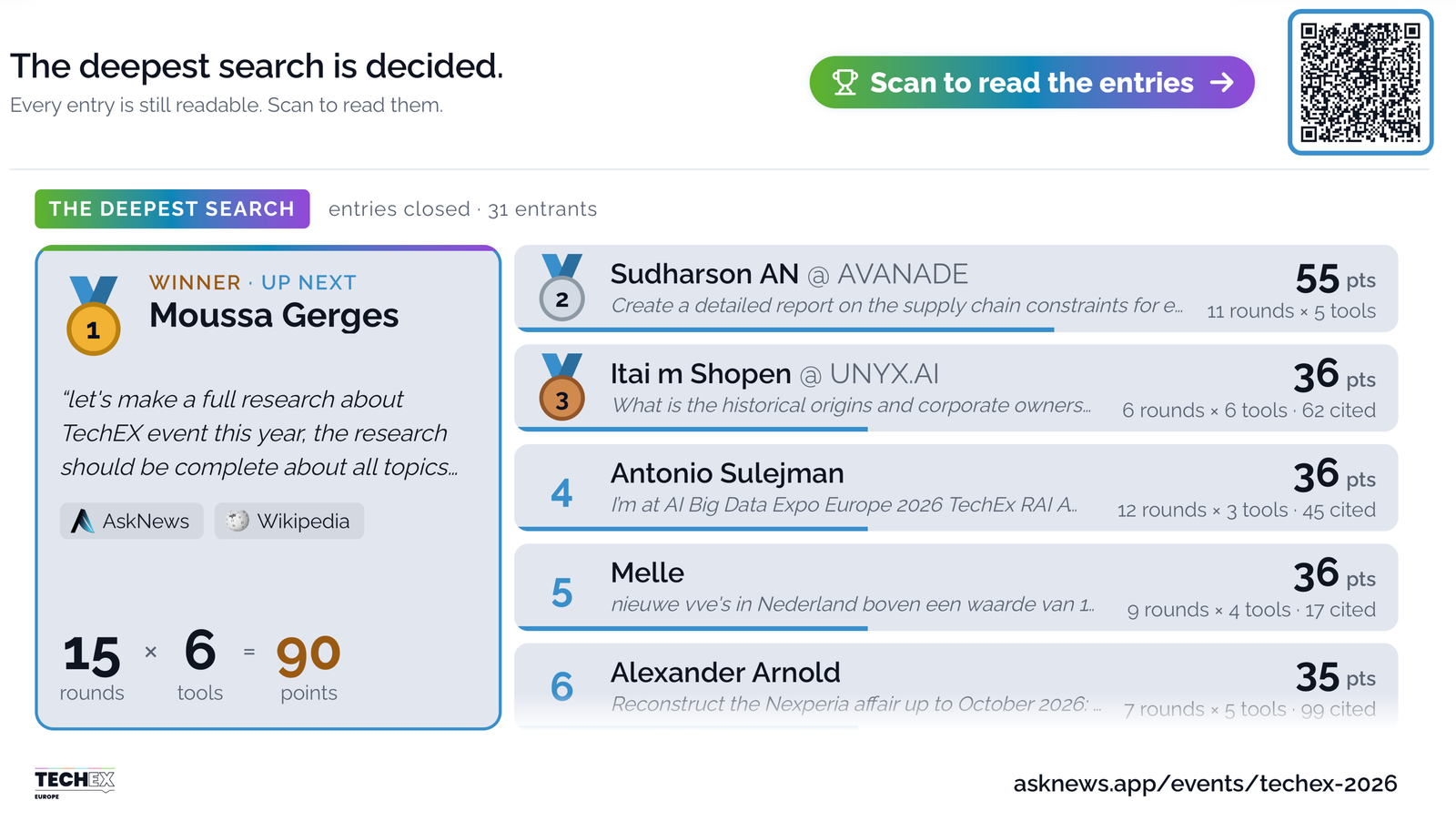
That margin is wide, and it is worth being precise about what it measures. Ninety points describes how far and how widely the agent searched. It says nothing about whether the resulting report is accurate or complete.
Here is Moussa's prompt, exactly as submitted:
let's make a full research about TechEX event this year, the research should be complete about all topics covered by the event. the report should be for all the technical backgrounds level so start by the simple junior topics and ideas going to more complex and detaild topics for senior. The report should cover the professional aspect and social aspect so make the search on the official websites and also search for personal blogs or posts of teh prevoius years so i can know at least what t expect for this year. Make all the needed research to cover all possible points so i can count on this report.
The organisers declared Moussa the winner with that score.
The full run is public: read the winning report. Its completed canvas records 50 tool calls, 147 sources with 67 of them cited, 946 entities, 404 relationships and a depth of 15. Google carried most of the load with 29 calls, AskNews followed with 11, X search ran 4 times and Reddit search 3, and Wikipedia, podcast search and graph search each ran once. That is seven tool types attempted. Podcast search came back empty, which leaves the six distinct tools that returned results and appear on the leaderboard. The 90 points are rounds times tools; they are not a count of tool calls.
The order of the searches tells the story. The agent opened broad, running TechEx 2026 searches across Google, AskNews and Wikipedia. From there it narrowed into regional and track-specific searches, then turned backwards in time to prior-year recaps and first-person accounts. It checked Reddit and X for the attendee view, and closed with a graph search across everything it had gathered.
The run was not tidy. Several Google searches returned nothing. The early entity set swept in an unrelated broadcast company and some drone-related entities, and the final report explicitly separates those from the conference. The 946 entities measure what the agent touched along the way, not how much relevant evidence it found.
What came out the other end follows the shape Moussa asked for: a junior orientation, intermediate coverage of the tracks, senior material on architecture and workshops, a networking section, prior-year accounts, a comparison and a limitations section. Because the question said "TechEx this year" without naming an edition, the report spans the London, North America and Europe events.
What going deeper revealed and where it stopped
The trace shows what happened: many rounds, several kinds of tool, a turn from official material to first-person accounts, and a final pass to connect entities. Why it went that deep is a separate question, and the answer is an interpretation rather than something the trace proves.
The most plausible reading is that the prompt carries several real research dimensions at once. It asks for an audience spanning junior to senior technical backgrounds. It wants the professional side of attending and the social side. It wants current information about this year's event and first-person perspectives from earlier years. Each of those dimensions gives the agent a reason to go back out, retrieve something different and fold it into the synthesis. That plausibly explains a broad, deep investigation. It does not show the question was the best one possible, or that the report is complete, and naming source types is no recipe for chasing a score. The interesting part is the range of perspectives the question asks for.
The report is candid about its own edges, which makes it more useful. It notes that detailed full-session abstracts could not be retrieved. Independent long-form reviews were scarce, and much of the available material was written by organisers or exhibitors. Reddit had no TechEx-specific threads. Official and third-party listings disagreed on dates. And no post-event wrap-up statistics existed yet.
Each round of research adds another perspective, another piece of evidence, another connection between entities. That moves you toward a high-fidelity understanding. When the result feeds a company workflow, report, forecast or analysis that people will act on with high confidence, the claims that matter still need verification.
That is the honest promise of iterative research. A single search returns pages. Repeated, contextual rounds build a picture in which people, organisations and events connect, and the gaps become visible too. Those visible gaps are part of the value: a report that says where its evidence ran thin tells a reader exactly what to check next.
Forecasting talk and taking the research home
Alongside the booth, Robert Caulk gave a talk titled "How AI Forecasters are beating humans in prediction markets". It sat naturally beside the competition. Forecasting is one of the workflows where an agent's view of the news, how current it is and how well it is connected, shapes what the agent can reason about.
The competition closed with the leaderboard above and €400 for Moussa.
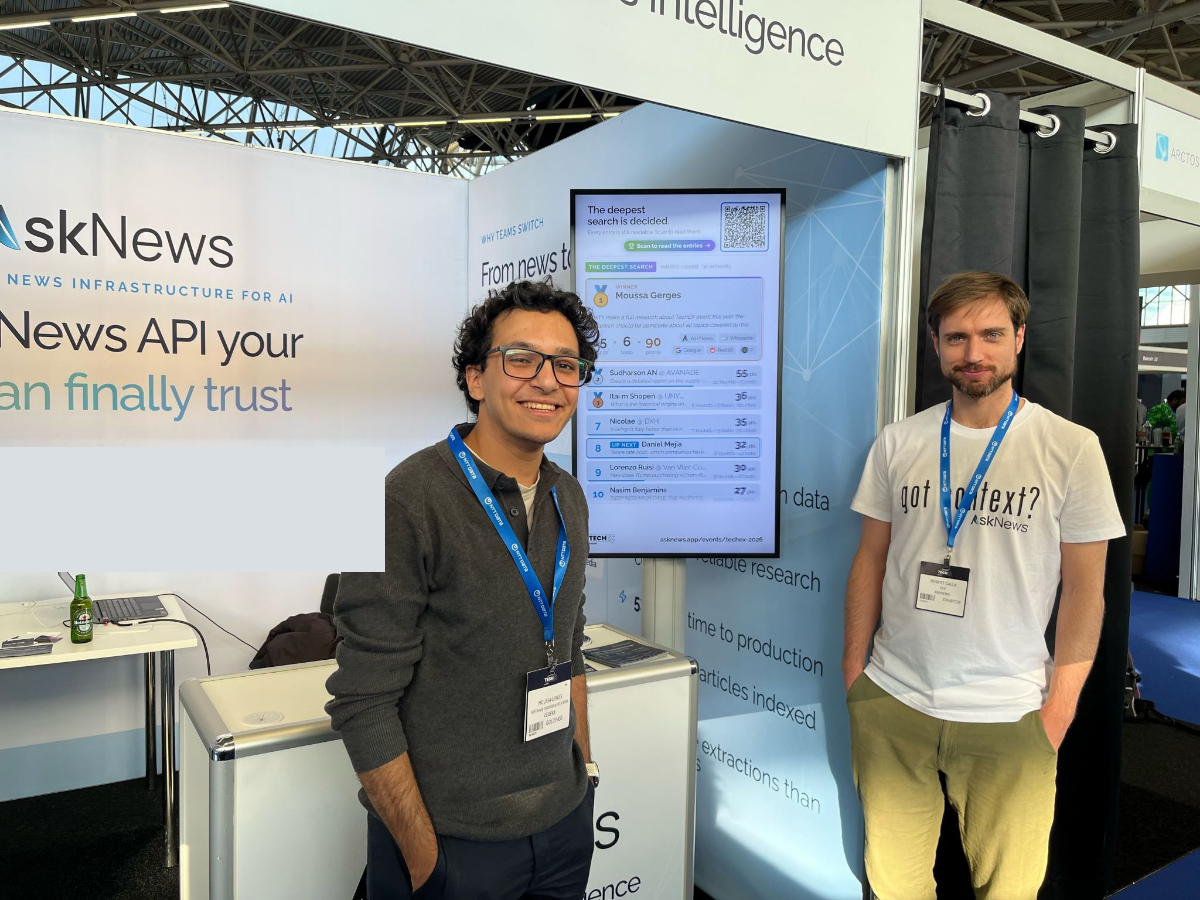
Congratulations to Moussa, and thanks to all 31 entrants who brought a question to the stand. The winning run is still open to read, dead ends and disambiguation included, and it is a fair picture of what deep, structured news research looks like when an agent has real reasons to keep going.