AskNews Partners with Top Publishers to Serve Booming News Analytics Market
Thousands of trusted global publishers are on-board, AskNews unlocks new pathways for AI-ready news data that protects publisher rights, improves LLM performance, and empowers intelligence workflows.
A New Business Model for a New Market
AskNews Publisher proudly announces formal licensing agreements with The Associated Press (AP) , Agence France-Presse (AFP), and over 1000 more publishers across Newstex and individual licensing agreements. These partnerships combine to power booming markets across prediction markets, financial systems, geopolitical analytics, intelligence agencies, academic research, and much more.
These publishers chose to monetize their high-value journalism through AskNews as a response to a rise in AI web-scraping and training, which is leading to fewer clicks and lower ad revenue. Not to mention, they are seeing commercial systems unlawfully trained on their hard-built journalistic archives.
Bridging Journalism and the AI Ecosystem
Large language models are transforming how we analyze, forecast, and respond to global events, but they’re only as reliable as the data they consume. Today, the news data available to LLMs is often messy, unstructured, scattered, and legally fraught. Scraped content lacks consistency. Summaries miss nuance. And uncontrolled scraping is brittle, risks violating publisher rights, is token intense, and hallucination prone.
AskNews offers a new approach rooted in our evidence-based research on context engineering - the process of preparing news information in a form that LLMs can easily access and reliably in ingest. We transform publisher material into synthetic, structured, and enriched documents that retain the reported facts but strip away any expressive language. These documents are optimized for LLM search, retrieval, ingestion and downstream analysis. But synthetic documents never include the publisher’s original text, which protects narrative style, intellectual property, and legal rights. Businesses get fast access to well structured data, publishers get risk-free revenue. Easy, peasy.
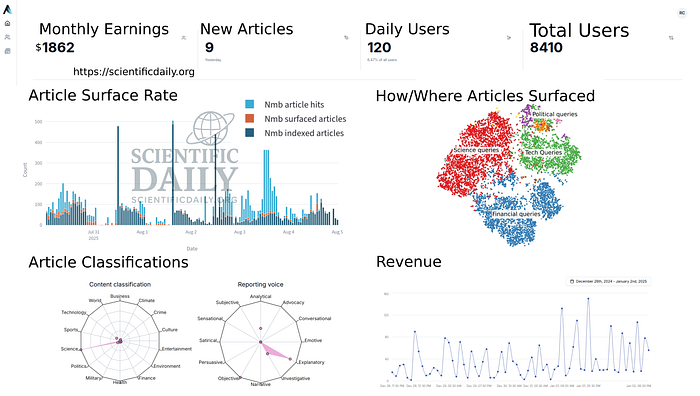
Our AskNews Publisher platform enables publishers to reach a rapidly growing segment of the information economy: research and high-stakes decision platforms that need factual, machine-readable signals from trusted news sources, not prose. AskNews is in direct service to publishers; 50% of AskNews revenue is distributed back to publishers based on article surface rates. In addition to the revenue share, publishers also get data rich usage analytics through the AskNews Publisher Dashboard.
“Our goal is to empower publishers to participate in the AI-driven information economy on their own terms,” said Robert Caulk, CEO of AskNews. “We believe the future of news is about enabling trusted information to flow into high-stakes research, forecasting, and analysis, with publishers controlling how their content powers these systems.”
AskNews x AP & AFP: A New Standard in Responsible AI Partnerships
At a time when publishers are justifiably cautious about how their content is used, AP and AFP are taking a visionary stance: supporting innovation without compromising control. By collaborating with AskNews, they ensure their journalism plays a foundational role in high-stakes decision-making environments, while their editorial voice, narrative style, and intellectual property remain fully protected.
“With 1,700 journalists in 150 bureaus worldwide, AFP brings trusted reporting from every corner of the globe. AskNews helps us reach new audiences in AI, analytics, and research — without ever compromising control, attribution, or integrity,” said Basil Maudave, Head of Strategic Partnerships at AFP.
The AskNews royalty model ensures that all 1000+ publishing partners are compensated whenever their information surfaces in our systems. Attribution is mechanical. Transparency is built in. This is more than just a licensing deal, it’s a blueprint for how publisher data should be handled in the AI era: with respect, precision, and shared value.
“At Newstex, we’ve always believed that high-quality journalism deserves high-integrity distribution,” said Michael Ellis, President of Newstex. “AskNews offers a forward-looking approach, one that gives our publishers new opportunities in the AI space without compromising their rights or voice.”
What Is Synthetic News Data?
Synthetic news data is not just a summary, it’s the output of evidence based research on context engineering: a structured, enriched, and machine-optimized representation of an article’s core facts, stripped of original narrative, style, or phrasing. At AskNews, we generate this synthetic layer to make high-quality journalism useful for machines while protecting the human voice that created it.
Unlike traditional summaries, which often compress and simplify for human readability, synthetic data is designed for systems. It retains the full factual content of a report: who, what, when, where, and why, and enhances it with metadata such as:
- Named entities (people, organizations, places)
- Topical categories (e.g., politics, business, conflict, science)
- Sentiment and provocative framing
- Geo-coordinates and locations
- Narrative voice and reporting tone
- Temporal anchoring and event sequences
- Statements and evidence
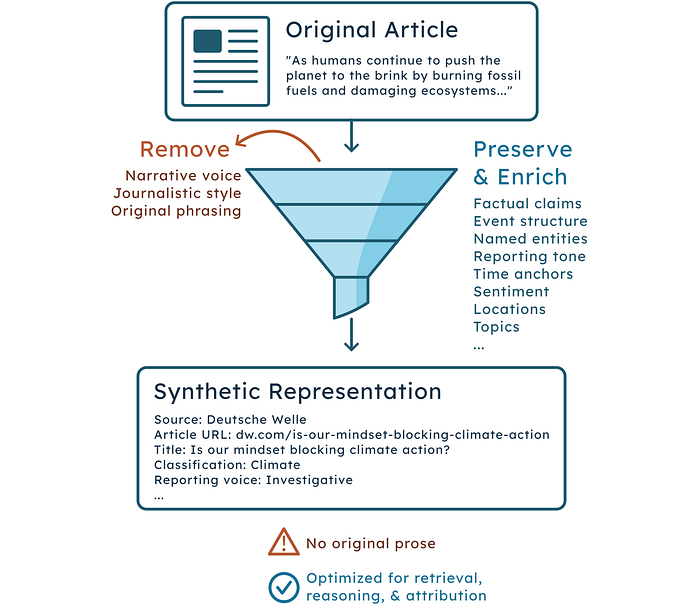
The result is a synthetic, factual index that enables more accurate retrieval, prompt construction, and automated reasoning, all without exposing the expressive identity of the publisher. Because we strip out style and structure, synthetic news is useless for training LLMs to mimic a publisher’s voice, but powerful for grounding LLMs in verified facts.
You can think of it as a library catalog for automated systems, not a cloning machine for publisher material.
Why This Matters: Solving the Context Crisis
The promise of generative AI hinges on one thing: context. Without it, even the most powerful models hallucinate, misattribute, or omit key facts. Nowhere is this more dangerous than in domains that rely on real-world knowledge, like policy analysis, forecasting, intelligence, or research.
The problem? Traditional news data is not structured for machines. Articles are optimized for human readers, not for LLMs. Scraped content is noisy and token intense. Summaries lack depth. And even when models do ingest news, they often do so out of context, missing the who, when, where, and why that make events meaningful. This is why context engineering is key.
AskNews solves this with synthetic news data: highly structured, fact-focused documents that distill what happened, link it to known entities, place it in time and space, and expose the relationships that define an unfolding story.
This kind of contextual precision enables:
- Reliable LLM Reasoning — Structured context improves prompt relevance and reduces hallucinations in complex AI workflows.
- Signal Extraction at Scale — Analysts can identify trends, patterns, and anomalies across thousands of stories in real time.
- Causal Forecasting — Systems track chains of events, actors, and outcomes, not just isolated headlines.
- Attribution and Accountability — Every surface is source-aware, traceable, and backed by original publisher metadata.
By providing clean, factual scaffolding for downstream tools, AskNews eliminates much of the risk and cost associated with free-text ingestion, and helps LLMs do what they’re meant to: think with context, not guess without it.
In fact, AskNews researchers and engineers have refined their context engineering services by iterating against LLMs participating in forecasting tournaments across the web. After 12 months and four real-time tournaments, AskNews data consistently fuels the winning forecasting bots.
“AI forecasting is a new frontier where every word counts. AskNews data is more reliable and more accurate than anything else out there that we could find,” said the Head of Bot Forecasting at Metaculus.
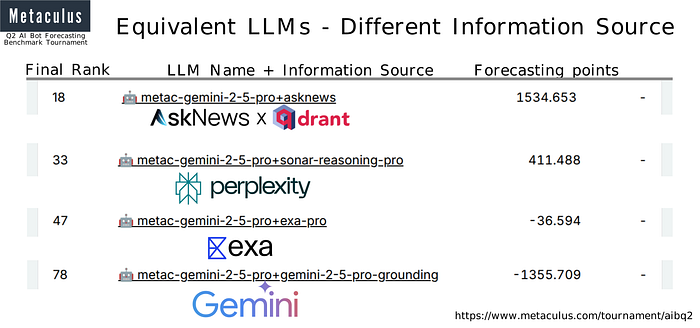
Context engineering isn’t easy, but when it’s done right, it unlocks incredible opportunities for these advanced reasoning LLMs.
“The entire AskNews system has been built around context engineering from day one,” said Elin Törnquist, Co-founder of AskNews. “Before the term caught on in the AI world, we were already focused on solving how to get machines to understand events, actors, timelines, and relationships. That foundation is what makes our data uniquely useful, and uniquely safe, for LLMs today.”
This commitment to structured, contextual data underpins every aspect of our product, from how we ingest content to how we deliver value to publishers and downstream users alike.
A Win-Win Model for Publishers
In a media environment where content is often scraped, cloned, or misused without consent, publishers have every right to be cautious. AskNews was built with a different philosophy: publishers should benefit from the AI boom, not be exploited by it.
With AskNews Publisher, we offer a model designed to protect editorial integrity:
- No content cloning — Our synthetic data strips away narrative style, voice, and phrasing. Your unique expression stays yours.
- Full editorial control — You decide what part of your content gets indexed, how it’s attributed, and where it appears.
- Guaranteed attribution — Every surface of synthetic content includes clear credit and source metadata.
- Transparent analytics — Track usage, royalties, and performance through the AskNews Publisher Dashboard.
- Effortless onboarding — Once you’re in, we do the rest: hitting your existing feed or crawling your website at predictable intervals without affecting your site performance.
This puts us in direct service to publishers. That’s why AskNews commits 50% of the search revenue to our publishing partners through a usage-based royalty model.

When your synthetic content surfaces, whether in our Newsplunker platform or via an API request, you earn a share of the revenue. It’s a scalable, transparent, and fair way to participate in the emerging AI economy without compromising your rights.
Here’s what that looks like in practice:
- A pay-per-surface royalty model ensures you earn revenue whenever your synthetic content surfaces.
- Transparent analytics via the AskNews Publisher Dashboard let you track usage and performance of your content.
- Your reporting reaches high-trust markets, from forecasting platforms and risk models to academic tools and LLM-powered applications.
- You gain exposure to a growing ecosystem of AI systems built on verified, structured information, not uncontrolled scraping.
Thousands of publishers are already showing what’s possible. AskNews Publisher offers a clear, controlled, and revenue-generating path into the AI future, without compromising what makes your journalism yours.
“AskNews is showing that it’s possible to build AI applications that respect journalistic integrity and publisher rights” said Steven Caulk, Editor-in-Chief at AskNews, “Their synthetic data model ensures that the core facts of traditional journalism can support analytics systems, without compromising brand, voice, or content ownership.”
With leading global publishers now helping shape the model, AskNews is demonstrating that AI and journalism can grow together, ethically, transparently, and profitably.
How Synthetic News Data Is Used: Real-World Applications
AskNews data powers a wide range of high-value use cases, all of which rely on trusted, structured information to make sense of fast-moving events. Our synthetic news layer isn’t just a technical convenience, it’s the backbone of real-time systems across forecasting, intelligence, research, and AI alignment.
Here’s how organizations are using our data today:
1. Analysts and Risk Teams
Track geopolitical developments, regulatory changes, and emerging risks with real-time, structured updates. Filter by location, topic, sentiment, or actor, and surface insights that would take hours to extract manually.
2. Forecasting and Prediction Markets
Feed probabilistic models and forecasting platforms with context-rich event data. AskNews structures the facts and timelines needed to make predictions grounded in evidence, not headlines.
3. Academic and Scientific Research
Power studies on media coverage, social trends, international relations, and more, without needing access to full copyrighted content. Structured metadata enables large-scale, ethics-compliant research.
4. Knowledge Graphs and AI Agents
Enable agents to reason over real-world events using our vector-searchable database and news knowledge graph. With synthetic data as context, LLMs can generate grounded, fact-aware outputs.
5. Journalism and Media Platforms
Use synthetic short-form content to serve readers on the go, power interactive experiences like “chat with the news,” or bring structure to archive search and internal analysis tools.
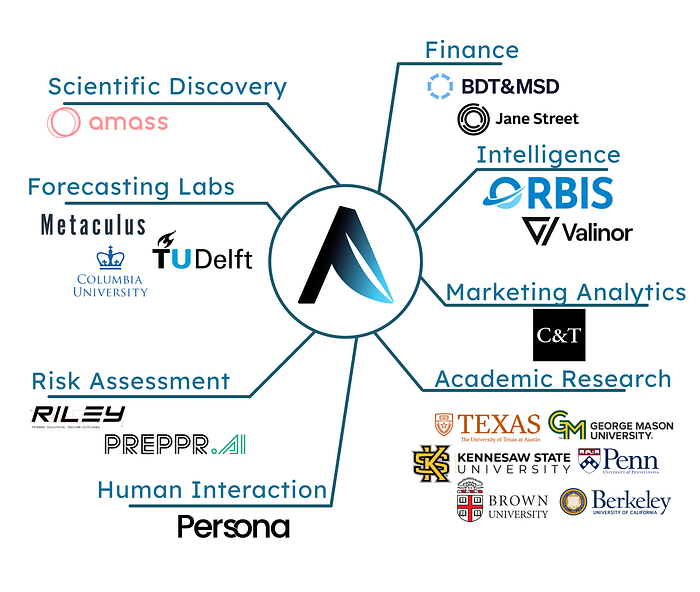
Whether through our API or via our Newsplunker platform, synthetic news data becomes a foundation for clarity, speed, and insight, without compromising publisher rights or editorial voice.
How It Works
AskNews transforms high-quality journalism into structured, synthetic documents through a secure and publisher-respecting pipeline. Whether content is licensed or sourced from the open web, we follow a consistent process designed for both technical precision and editorial protection.
This pipeline is built around a core principle we’ve championed from the start: context engineering, the process of extracting, structuring, and enriching content so that AI systems can understand not just what happened, but how it fits into the world.
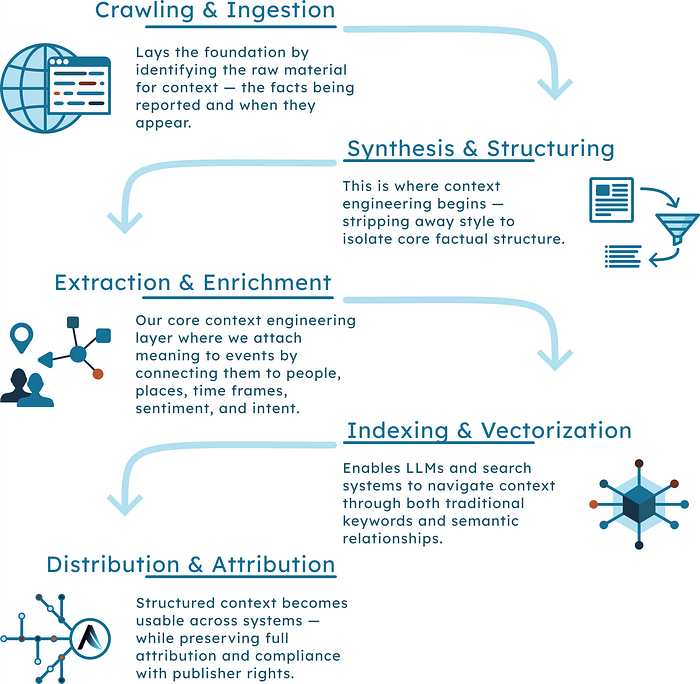
Step 1: Crawling and Ingestion
We pull from dedicated feeds if publishers have them, if not, we crawl content directly from publisher sites at low, predictable frequencies that avoid any server overload.
Step 2: Synthesis and Structuring
This is where context engineering begins. Each article is summarized and stripped of expressive elements like narrative voice or phrasing. The result is a synthetic version that preserves factual content, optimized for LLMs, not for readers or training models.
Step 3: Extraction and Enrichment
Our core context engineering layer: we attach meaning to events by connecting them to people, places, time frames, sentiment, and intent. Based on our state of the art research on knowledge graphs, entity extraction, and bias detection. The extracted and enriched metadata includes:
- Named entities (people, organizations, places)
- Geo-coordinates and event locations
- Topic classification and story type
- Sentiment, voice, and provocative framing
- Temporal markers and causal linkages
Step 4: Indexing and Vectorization
All content is stored in a Qdrant vector database and indexed with traditional and semantic search capabilities. This makes it possible to retrieve information via keyword queries, natural language prompts, or embedding-based search.
Step 5: Distribution, Attribution, and Analytics
Synthetic data is made available via the AskNews API and through the Newsplunker platform. Every use includes source attribution and is tracked through our royalty engine, ensuring transparency and compensation for publishers. High-value usage analytics are made available to publishers via our Analytics Dashboard (example below).
This system turns unstructured news into structured intelligence, at scale, in real time, and with the publisher always in the loop.
A Call to Action for Forward-Thinking Publishers
The relationship between journalism and AI is being rewritten in real time, and publishers have a choice. They can sit on the sidelines as their content is scraped, repackaged, and absorbed into opaque models. Or they can take the lead in shaping how news data powers the next generation of intelligence systems.
AskNews Publisher offers a path forward. It’s built for publishers who want to retain control of their voice and IP, while earning fair compensation as their reporting informs high-trust, high-impact platforms. Our model shows that it’s possible to engage with AI on your terms, with transparency, attribution, and revenue baked in.
Learn more about AskNews Publisher →
Contact
Publisher interested in joining? Email [email protected] to get more information.
Business interested in building on reliable, licensed, LLM-ready data? Head over to https://my.asknews.app/plans to gain access to the system.
Researcher interested in our open-source bias, entity, and knowledge graph research? Check out our models, datasets, publications, and presentations:
HuggingFace: https://huggingface.co/EmergentMethods
Publications: https://emergentmethods.ai/publications.html
Presentations: https://emergentmethods.ai/publications.html#prese-publications