2026 S&P 500 Market Forecast
Comprehensive Analysis & Key Insights
A deep dive into where the S&P 500 is headed in 2026,
analyzing AI investment trends, Trump administration
policies, Fed decisions, and the factors that could
drive or invert this forecast.
|
|
Year-End 2026 Target
7,400-7,600
10-12% Gain from Current Levels
Current Level: ~6,850 | Bull Case: 8,000+ | Bear Case:
6,350-6,800
|
Wall Street Consensus
Deutsche Bank: 8,000 (Most
bullish—AI-driven earnings growth)
Morgan Stanley: 7,800 ("New bull
market" beginning)
Wells Fargo: 7,800 (Two-phase rally:
inflation hopes then AI)
JPMorgan: 7,500 base case, 8,000+
possible with more Fed cuts
HSBC: 7,500 (AI capex to exceed
$500B)
UBS: 7,500 (14.4% EPS growth
projected)
Barclays: 7,400 (Cautious on market
polarization)
Société Générale: 7,300 (Base case with
rate cuts)
Reuters Survey Median (45+ strategists):
7,490
|
Major Factors Supporting the Forecast
|
AI-Driven Capital Expenditure Boom
AI-related capital expenditure is projected at $585
billion over the next 12 months—a 34% year-over-year
increase. This creates a powerful multiplier effect
across semiconductors, data centers, utilities, and
related sectors, with JPMorgan noting that AI
productivity benefits remain "underappreciated."
|
Strong Corporate Earnings Growth
S&P 500 companies delivered 13.4% earnings growth in Q3
2025, marking the fourth consecutive quarter of
double-digit growth. Analysts project 13-15% EPS growth
over the next two years, with 2026 EPS estimates around
$320.
|
Federal Reserve Rate Cuts
The Fed is highly likely to cut rates in December 2025
(84-87% probability). The base case assumes two
additional 25-basis-point cuts in 2026, bringing the
federal funds rate to approximately 3.4% by year-end
2026.
|
Broadening Market Participation
After years of narrow leadership by the "Magnificent
Seven" tech stocks, earnings growth is expected to
broaden into financials, industrials, healthcare, and
cyclical sectors as AI benefits spread throughout the
real economy.
|
Trump Administration Policy Impact
The administration's policies represent both
opportunities and risks. Here's the breakdown:
|
Positive Factors
Tax Cuts:
Extension of 2017 TCJA plus additional corporate tax
rate reductions from 21% to potentially 15%, boosting
after-tax earnings.
Deregulation:
Financial deregulation could unlock $13-219 billion in
additional bank lending capacity. Reduced regulatory
burden improves profit margins.
Pro-Business Sentiment:
Focus on corporate profitability, especially in
technology, energy, and finance sectors.
|
Negative Factors (Key Risks)
Tariffs and Inflation:
This is the single biggest risk. Tariffs on China (60%),
Canada, Mexico are structurally inflationary. Could add
0.75-1% to annual inflation, potentially reaching
3.2-4.3% in 2026.
Trade War Uncertainty:
Ongoing tensions disrupt supply chains and increase
business costs. WTO projects global trade growth will
slow to just 0.5% in 2026.
K-Shaped Economy:
Wealth gap widening dramatically. One in seven Americans
experiencing food insecurity, consumer sentiment at
historic lows, unemployment rising. Creates recession
risk if consumer spending (70% of GDP) collapses.
|
What Could Invert This Forecast?
|
Downside Scenarios (6,350-6,800)
AI Bubble Burst: S&P 500 P/E ratio at
22-25x vs. 15.3x historical average. Shiller CAPE
exceeds 33, approaching dot-com levels. Six largest
companies account for one-third of S&P 500 market cap.
If AI spending fails to generate returns, the rally
could reverse violently.
Fed Independence Crisis: Kevin Hassett
is leading candidate to replace Jerome Powell (term ends
May 2026). His dovish stance aligns with Trump
preferences, raising concerns about monetary policy
credibility. Excessive rate cuts could reignite
inflation, forcing sharp reversal.
Data Transparency Issues: 43-day
government shutdown created data gaps—October
unemployment not released, GDP and inflation data
delayed. Fed making decisions without complete labor
market information. Hidden weakness could be revealed
when data resumes.
Tariff & Supreme Court Risk: Supreme
Court reviewing Trump's tariff authority. If struck
down, $100+ billion in refunds required. If upheld,
inflation persists above Fed's 2% target, forcing policy
pause.
Consumer Spending Collapse: Consumer
confidence at record lows (51%). K-shaped economy:
high-income thriving, low-income struggling. If stock
market falls, wealth effects could trigger recession as
consumer spending (70% of GDP) contracts.
Midterm Election Volatility: S&P 500
averages only 3.3% gains in midterm years (positive just
54% of the time). 2026 midterms create policy
uncertainty, particularly in Q1-Q2.
|
Upside Scenarios (Above 8,000)
Aggressive Fed Easing: If the Fed cuts
rates three or more times in 2026, falling yields would
support multiple expansion toward 8,000+.
Tariff Moderation: If Trump uses
tariffs purely as negotiation leverage and ultimately
implements moderate increases, inflation fears would
ease and markets would rally.
AI Productivity Breakthrough: If AI
delivers measurable productivity gains that offset
inflation and boost profit margins beyond expectations,
earnings could exceed $320 EPS.
|
Interactive Dashboard
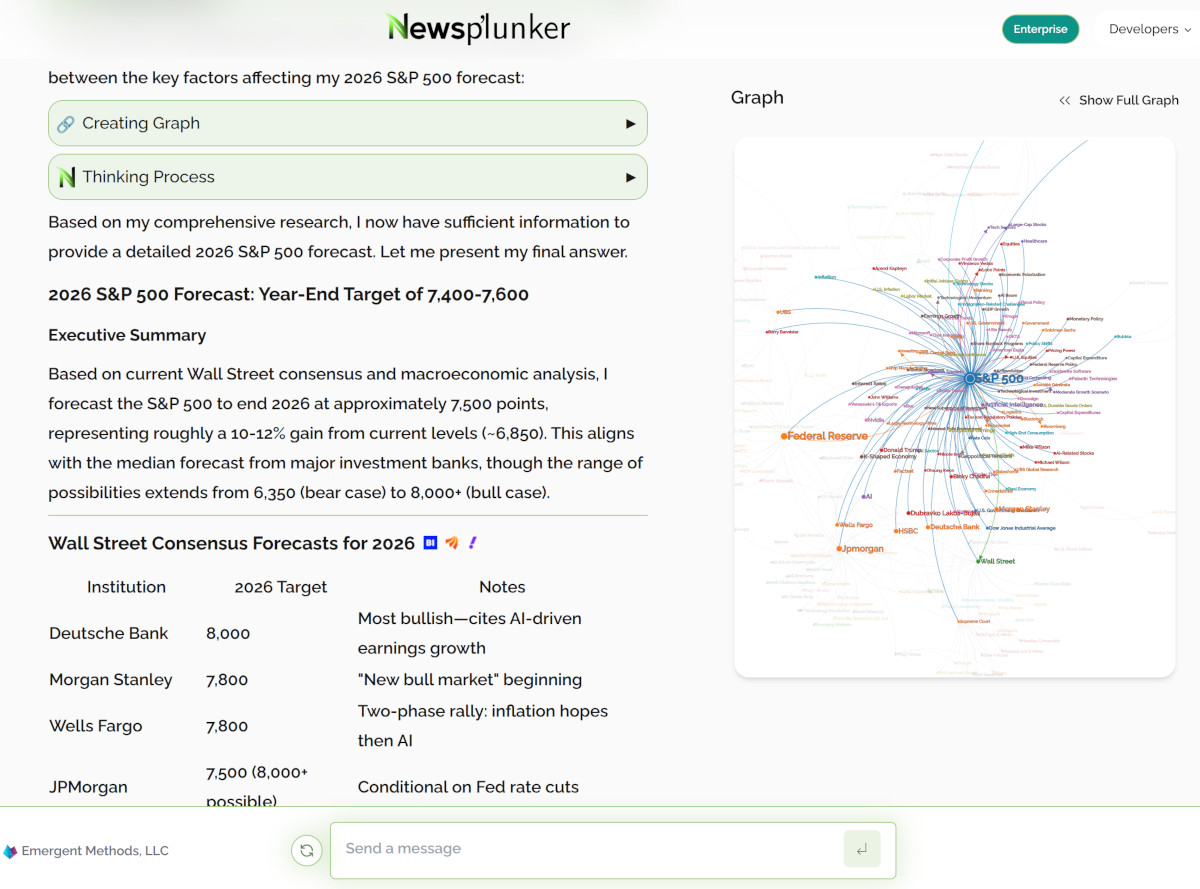
Click the image above to explore the full interactive
dashboard
|
The Bottom Line
The S&P 500 is likely to reach
7,500 points by year-end 2026 (midpoint
of range: 7,400-7,600), representing approximately
+10% gain from current levels (~6,850).
This base case (50% probability) assumes 2-3 Fed rate
cuts, 12-14% earnings growth, moderate tariff
implementation, and continued AI investment.
Critical Risk Factors:
AI bubble concerns (stretched valuations with Shiller
CAPE at 33), Fed independence under new leadership
(Kevin Hassett replacing Powell), data transparency
issues from 43-day shutdown, Supreme Court tariff
ruling, and midterm election volatility. Bull case
(8,000+, 25% probability) requires aggressive Fed easing
and tariff moderation. Bear case (6,350-6,800, 25%
probability) triggered by AI disillusionment, policy
errors, or consumer collapse.
Investment Strategy: Monitor December
Fed decision, Fed Chair appointment (expected before
Christmas 2025), Supreme Court tariff ruling, and
resumption of government data releases. Expect
significant volatility (10-15% corrections) throughout
the year, particularly Q1 2026. Maintain diversified
exposure emphasizing AI beneficiaries, financials
benefiting from deregulation, and value stocks. This is
not a "set it and forget it" year—active management
essential.
|
|
About NewsPlunker
NewsPlunker by AskNews provides comprehensive market
analysis powered by advanced AI and real-time news
intelligence. Get deeper insights into the markets that
matter most. Join our Discord community or email us at
[email protected].

|
|
AskNews - News, when quality matters.
Emergent Methods, LLC, Denver Colorado, USA
Unsubscribe
© 2025 Emergent Methods LLC All rights reserved.
|
|
|